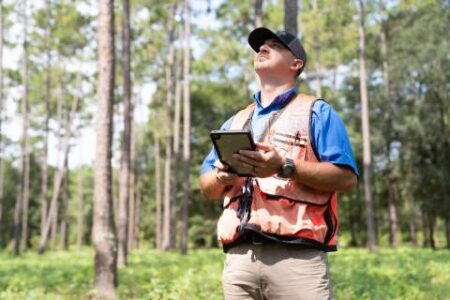

The Forestry graduate program at the University of Georgia equips students with the scientific knowledge and technical skills needed to address complex challenges in forest ecosystems and industries. Our graduates are in high demand across a range of forest-related industries.

The curriculum blends foundational forestry knowledge with cutting-edge research and applied skills across diverse specialization areas. Students can expect to engage in interdisciplinary forestry coursework, field-based learning, and research that addresses the operational, ecological, technological, and economic dimensions of forest systems. Graduates can earn a Master of Forest Resources (MFR), Master of Science (MS) or Doctor of Philosophy (PhD) in Forestry, depending on their academic and professional goals.

Warnell’s Forestry program combines the principles of ecology, silviculture, mensuration, economics, finance, statistics, and operations research in the decision-making process aimed at achieving the goals and objectives of forest landowners and the timber industry. Our faculty and graduate students use new and emerging technology to develop innovative ways of measuring and assessing forests, and to understand the growth and development of forest populations and communities. This work leads to breakthroughs in forest management practices, pest management, and disaster mitigation.

Research Areas

AI, Precision Forestry, & Remote Sensing
  • Focus on digital tools, drone technology, and data analytics for forest monitoring and decision-making.
  • Faculty: Bettinger, Lowe, & Lui
  • Potential Job Titles:
    • Remote Sensing Analyst
    • Precision Forestry Specialist
    • GIS/Geospatial Analyst
    • Forest Data Scientist
    • UAS (Drone) Operations Manager
Forest Biology & Ecology
  • Please see the Forest Biology Area of Emphasis for more information.
  • Study forest ecosystems, species interactions, and ecological restoration.
  • Faculty: Aubrey, Johnson, Markewitz, Merkle, & Tsai
  • Potential Job Titles:
    • Forest Ecologist
    • Restoration Ecologist
    • Conservation Scientist
    • Environmental Consultant
Biometrics & Silviculture
  • Emphasize quantitative modeling and silvicultural techniques for forest growth and productivity.
  • Faculty: Bullock, Munro, Clabo, Dickens, Kinane, Yang, and Zhao
  • Potential Job Titles:
    • Forest Biometrician
    • Silviculturist
    • Forest Inventory Analyst
Forest Economics, Finance, and Taxation
  • Analyze forest markets, investment strategies, and fiscal policies affecting forest landowners.
  • Faculty: Li, Silva, and Siry
  • Potential Job Titles:
    • Forest Economist
    • Timberland Investment Analyst
    • Timberland Portfolio Manager
    • Natural Resource Economist
    • Forestland Appraiser
Forest Health
  • Investigate forest pests, diseases, and integrated health management strategies.
  • Please see the Forest Biology Area of Emphasis for more information
  • Faculty: Bargeron, Gandhi, McCarty, and Villari
  • Potential Job Titles:
    • Forest Health Specialist
    • Forest Entomologist
    • Forest Pathologist
    • Invasive Species Coordinator
    • Pest Risk Analyst
    • Plant Health Scientist
Forest Operations, Management, & Supply Chain Logistics
  • Optimize forest management techniques to improve business operations; and optimize forest harvesting, transportation, and logistics systems for efficiency and sustainability.
  • Faculty: Bettinger, Bolding, and Conrad
  • Potential Job Titles:
    • Forest Operations Manager
    • Wood Procurement Forester
    • Forest Planner
    • Harvest Planning Coordinator
    • Supply Chain Analyst
Wood Products
  • Explore material science, product innovation, and sustainable manufacturing in forest-based industries.
  • Faculty: Dahlen and Cai
  • Potential Job Titles:
    • Wood Products Researcher
    • Product Development Scientist
    • Sustainability Analyst (Wood Industry)
    • Quality Control Manager (Wood Manufacturing)

Program Outcomes and Career Paths

Goals of the Program
  • Help students develop deep, discipline-specific knowledge in forest ecology, silviculture, biometrics, and resource management to address complex environmental and industry challenges.
  • Encourage integration of ecological, technological, and economic perspectives to solve real-world forestry problems through collaborative, cross-disciplinary approaches.
  • Support career readiness for roles in academia, industry, government, and nonprofit organizations by emphasizing applied skills, research experience, and leadership development.
  • Promote sustainable forest stewardship through evidence-based practices that balance ecological integrity, and economic viability.
  • Support innovation in forest technology, health, and product development.
  • Train students to effectively communicate complex forestry concepts to technical and non-technical audiences and lead interdisciplinary teams in diverse professional settings.
  • Guide students in conducting impactful research that advances scientific understanding, informs policy, and contributes to innovation in forest science and management.
Job Opportunities
  • A graduate degree in Forestry from Warnell equips students with the knowledge and skills to pursue diverse careers in forest science, management, and technology across both the private and public sectors. Through interdisciplinary training in forestry and natural resources, students are prepared for leadership roles in research, policy, and forest stewardship that shape the future of forest landscapes and the timber industry.
  • In the private sector, graduates often work for:
    • Forest products companies where they contribute to operations, supply chain logistics, and sustainability initiatives.
    • Forestry consulting firms that specialize in forest inventory, ecological assessments, and land-use planning.
    • Timberland Investment Management Organizations (TIMOs) and Real Estate Investment Trusts (REITs) that manage large forestland portfolios.
    • Technology and geospatial firms developing AI, remote sensing, and GIS tools for forest monitoring and precision forestry programs.
  • In the public sector, graduates find opportunities with:
    • Federal agencies like the U.S. Forest Service, Natural Resources Conservation Service, and National Park Service, working in forest management, fire ecology, and policy development.
    • State forestry agencies, such as the Georgia Forestry Commission, where they may lead reforestation, forest health, forest inventory and analysis (FIA), and landowner assistance programs.
    • Non-governmental organizations (NGOs) and conservation groups focusing on sustainable land management and biodiversity conservation.
    • Higher education and academia where they conduct research, teach, and/or lead outreach program to generate new knowledge in the forestry field, train future foresters, and educate stakeholders on innovate technologies.
Job Title Examples
  • Forest Resource Manager
  • District or Regional Forester
  • Forest Operations Manager
  • Forest Planning Analyst
  • Forest Health Specialist
  • Forest Policy Advisor
  • Restoration Ecologist
  • Land Management Specialist
  • Wood Procurement Forester

Curriculum

What degree path do students need to pursue with this area of emphasis?  

  • Students can pursue a non-thesis Master of Forest Resources (MFR), a Master of Science (MS), or a Doctor of Philosophy (PhD) in Forestry.

Course ID

Name

Hours

Required for MFR :

FORS 3010/L

Dendrology

3

FARN 3200W/L

Ecology of Natural Resources

4

FORS 6010/L

Silviculture

4

FORS 6610/L

Forest Mensuration

4

FORS 6620

Timber Management

4

Accreditation

The educational program in forestry leading to the MFR in general forestry degree is accredited by the Society of American Foresters (SAF) under its Forestry standard.

SAF accreditation logo

Questions?

For general questions about pursuing a graduate degree at Warnell, contact a member of the graduate team:

Dr. Kyle Maurice Woosnam, Graduate Coordinator
Office: 1-301A
Phone: 864-653-0167
Email: [email protected]

Kate deDufour, Graduate Program Administrator
Office: 1-217
Phone: 706-542-1183

Prospective students should also contact faculty members for questions specific to this disciplinary area. Please check faculty members’ personal pages for information about their individual research interests and projects to ensure that you are contacting the most relevant ones.

The Latest News from Warnell

Jeffrey Todd Petty Headshot
Lili Cai headshot
Jeffrey Todd Petty Headshot

Find Your Path

Shape the Future of Forestry, Conservation & Sustainability