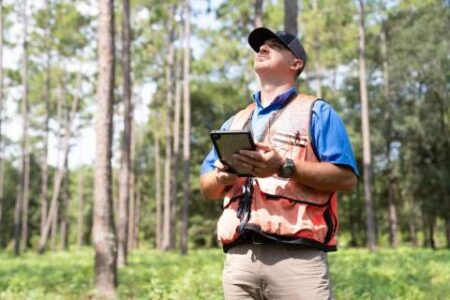

Program Overview

Forestry is a major economic engine in the South, with forest products playing a role in thousands of everyday items, from construction materials to paper goods and bioenergy. At Warnell, when you pursue the Bachelor of Science in Forest Resources (BSFR) degree, you’ll be part of a program consistently ranked among the top five in the nation.

You’ll learn how to sustainably manage forest lands to meet society’s growing needs for wood, clean water, wildlife habitat, outdoor recreation, and biodiversity conservation. The curriculum prepares you to become a leader in forest management, conservation, and environmental stewardship by providing a strong foundation in practical fieldwork and science-based decision making.

The BSFR-Forestry major at the Warnell School of Forestry and Natural Resources is accredited by the Society of American Foresters (SAF) under its Forestry Standard, ensuring a rigorous and industry-relevant education.

SAF Accredited icon

What You’ll Gain

The forestry major emphasizes hands-on fieldwork, collaborative problem-solving, and the development of critical thinking skills. You’ll gain a deep understanding of forest ecosystems and the diverse ways people interact with and depend on forests.

Core topics covered include:

  • Forest economics
  • Forest health and ecology
  • Forest soils and hydrology
  • Geospatial analysis and mapping
  • Natural resources policy
  • Silviculture and forest regeneration
  • Timber harvesting and operations

You’ll build on these core topics through elective courses that introduce you to a variety of relevant forestry topics, including:
AI & Precision Forestry – Use drones, remote sensing, and data analytics to monitor forest health and support smart decision-making.

  • Biometrics & Silviculture – Apply quantitative modeling to enhance forest growth and productivity.
  • Forest Biology & Ecology – Study species interactions, forest regeneration, and ecological restoration.
  • Forest Economics, Finance, & Taxation – Analyze timber markets, land valuation, and investment strategies
  • Forest Health – Address forest pests, diseases, and abiotic stressors.
  • Forest Operations & Supply Chain – Optimize harvesting, transportation, and logistics systems.
    Natural Resources Policy & Societal Issues – Examine the intersection of forest management, policy, and public engagement.
  • Wood Products – Explore sustainable manufacturing, product innovation, and material science.

Many courses feature outdoor laboratories at nearby forests, including Whitehall Forest, Warnell’s 840-acre teaching forest dedicated to education and research that is just a short drive from UGA’s campus. You’ll also participate in a three-week intensive forestry field camp, traveling across Georgia and the Southeast to meet industry professionals, tour forest stands and mills, and sharpen your field skills, preparing you for internships and full-time jobs.

Courses & Curricula

The University of Georgia’s official guide to degree programs, courses, and academic requirements.

Careers & Outcomes

With a strong job market, competitive salaries, and meaningful work in a sustainability-focused industry, a degree in forestry offers both stability and purpose.

Common Job Titles 

  • County, State or Federal Forester
  • Forest Analyst
  • Forester
  • Forestry Technician
  • Inventory Forester
  • Land Protection Specialist
  • Prescribed Fire Technician
  • Procurement Forester
  • Silviculture Forester
  • Utility Forester

Employers & Sectors 

Graduates are well-prepared for high-demand careers, and potential career paths include:

  • Conservation and wildlife agencies (e.g., US Fish and Wildlife Service)
  • Forestry, land management, or environmental consulting (e.g., American Forest Management, F&W Forestry Services, Larson & McGowin)
  • Government and nonprofit organizations (e.g., Bureau of Land Management, Florida Forest Service, Georgia Forestry Commission, Georgia Power Company, U.S. Forest Service)
    Timber and forest product industries (e.g. Interfor, PotlatchDeltic, Rayonier, Weyerhaeuser)

Graduate & Professional Pathways 

Many students continue their education through graduate programs in forestry, forest resources, natural resource management, or related fields, including the Master of Forest Resources (MFR) through the Harley Langdale Jr. Center for Forest Business, which provides advanced training in forest business, finance, and management.

Hands-on Opportunities

Research Opportunities

Highly talented and motivated undergraduate students may have the opportunity to learn research skills by supporting faculty with their research. Forestry faculty research areas include:

  • AI and Precision Forestry: Machine learning for forest inventory, drone-based remote sensing, and automated decision support systems.
  • Biometrics & Silviculture: Growth and yield modeling, stand dynamics, and silvicultural prescriptions for sustainable management.
  • Forest Biology & Ecology: Biodiversity conservation, forest regeneration, and climate change impacts on forest ecosystems.
  • Forest Economics, Finance, & Taxation: Timber market analysis, forestland valuation, timberland portfolio optimization, and taxation strategies for private landowners.
  • Forest Health: Invasive species management, pest and pathogen outbreak modeling, interactions between biotic and abiotic stressors.
  • Forest Management, Operations & Supply Chain Logistics: Optimization and improvement of forest stand management, harvesting systems, transportation networks, and forest product flows.
  • Wood Products: Innovation in engineered wood, life cycle analysis, and sustainable product development.

Senior Project 

Warnell’s Senior Project is a capstone experience that allows you to apply skills learned in class to a real-world land and timber management challenge, producing a professional forestry plan for an external client.

Student Organizations 

SAF Forestry Club

The Latest News from Warnell

Headshot of Chad Bolding

Find Your Path

Shape the Future of Forestry, Conservation & Sustainability